


What is a structural steel fabricator
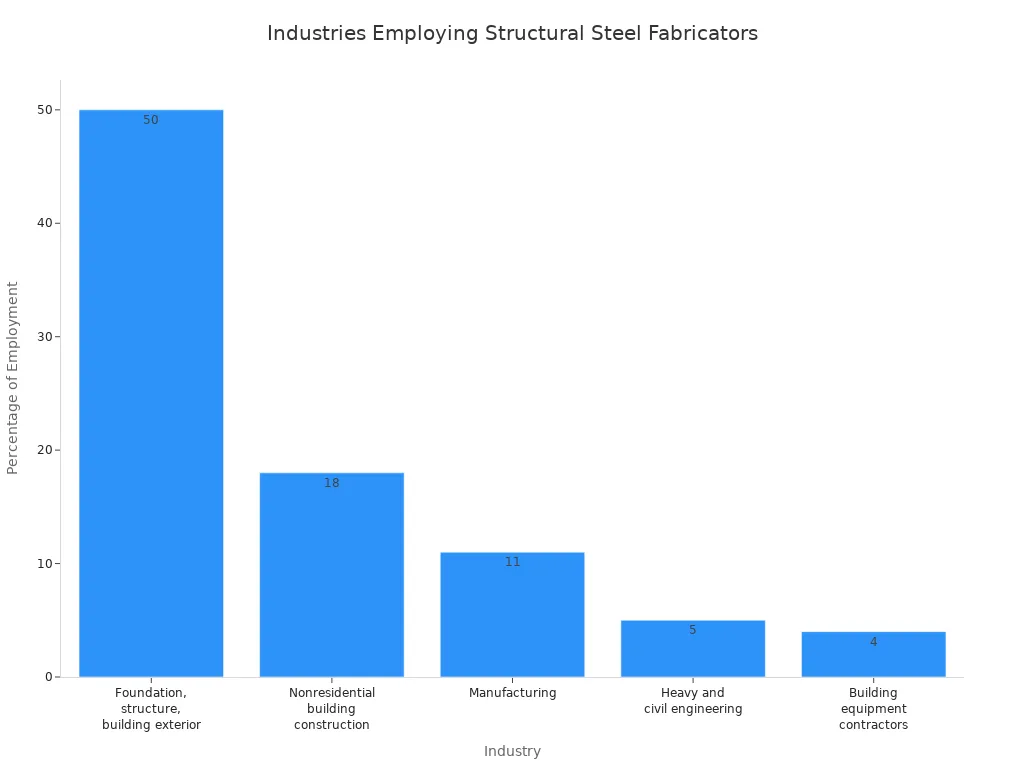
You work as a structural steel fabricator when you build and shape steel parts used in buildings, bridges, and factories. Your job involves turning raw steel into strong frameworks that hold up large structures. Many companies need your skills. Most jobs come from foundation, structure, and building exterior contractors, but you also find work in nonresidential construction, manufacturing, and heavy engineering.
Key Takeaways
Structural steel fabricators turn raw steel into strong frameworks for buildings and bridges, ensuring safety and stability.
Reading blueprints accurately is crucial. It helps avoid costly mistakes and ensures that every steel component fits perfectly.
Using modern tools like CNC machines and laser cutters improves precision and reduces waste during fabrication.
Quality control is essential. Inspecting materials and welds at every step guarantees that the final product meets safety standards.
Safety practices are a top priority. Wearing protective gear and following safety protocols keeps fabricators and their teams safe.
Structural Steel Fabricator Responsibilities
As a structural steel fabricator, you play a vital role in turning design ideas into real steel structures. You handle many tasks that require attention to detail, technical skill, and a strong focus on safety and quality. Let’s break down your main responsibilities.
Reading Blueprints and Plans
You start by reading blueprints and plans. These documents show you exactly what to build and how each piece should fit together.
Steel detailing gives you clear instructions so you can manufacture every component and assemble them correctly on-site. This step helps you avoid costly mistakes and delays.
You use both your skills and technology to interpret these plans:
AI tools help you read structural drawings and identify member labels, sizes, and quantities.
You check the AI outputs to make sure everything matches the project requirements.
You solve any unclear notes or exceptions in the drawings.
You evaluate if the design can be built and if it fits your shop’s capabilities.
You also prepare material takeoffs and cutting lists. These lists help you organize your work and make sure you have the right materials for each job.
Material Handling and Preparation
You handle and prepare steel materials before fabrication begins.
You inspect incoming steel to verify certifications, dimensions, and surface conditions.
You store materials properly to prevent corrosion and contamination.
You track materials for traceability, making sure you know where each piece goes.
Modern fabrication shops use CAD and CAM systems to improve precision and reduce waste. CNC machines, plasma cutters, and laser cutters help you achieve clean edges and accurate cuts. Automated welding systems provide consistent quality, but you still rely on skilled welders for complex tasks.
Here’s a table showing common challenges you face during material preparation:
Challenge | Description |
|---|---|
Material Quality | Steel can get damaged during shipping or storage, causing quality issues. |
Welding Problems | Issues like porosity and misalignment can delay inspections. |
Misalignment | Bolt holes and connections may not fit, requiring rework and causing delays. |
Surface Coatings | Incorrect coatings can lead to corrosion and wear, needing rework. |
Delivery Delays | Late or early deliveries disrupt project timelines. |
Weak Quality Control | Poor QC can result in incorrect dimensions and weld failures. |
Cutting and Shaping Steel
You cut and shape steel to match the project’s needs. You choose the right method based on steel thickness, position, and access.
No single method works for every job. You select the process that fits the material and precision requirements.
Common cutting methods include:
Laser cutting: High precision for complex shapes on thin to medium steel.
Plasma cutting: Fast and cost-effective for thicker metals.
Waterjet cutting: Clean cuts without heat damage.
Shearing: Quick, straight cuts on sheet metal.
Flame cutting: Used for thick sections.
For shaping, you use:
Press brakes and rolling machines for bending.
Punching holes and creating openings.
Stamping for repetitive shapes.
Here’s a table showing how you select processes based on steel form:
Steel Form | Suitable Processes |
|---|---|
Steel Bars | Various cutting and shaping methods |
Steel Wires | Specific bending and welding techniques |
Steel Plates | Precision cutting and assembly methods |
Assembly and Quality Control
You assemble steel components and check their quality at every step.
Rigorous inspection procedures ensure your work meets engineering specifications and safety standards.
You follow these steps for quality control:
Inspect materials to confirm they meet standards.
Verify design specifications for accuracy.
Check the cuts and shapes of steel components.
Inspect welds for strength, size, and defects.
Measure dimensions and alignment for proper fit.
Evaluate surface coatings to protect against corrosion.
Perform final inspection and testing before delivery.
Safety is always a priority. You wear personal protective equipment like hard hats, steel-toed boots, gloves, and safety goggles. You follow permit-to-work systems for high-risk tasks and attend safety training. You use fall protection measures, maintain equipment, and prepare for emergencies with first-aid kits and fire extinguishers.
Tip: Always double-check your work and follow safety guidelines to prevent accidents and ensure the structure’s integrity.
By mastering these responsibilities, you help create strong, reliable steel frameworks that support buildings, bridges, and factories.
Structural Steel Fabrication Process
Inspection and Planning
You begin the fabrication process by reviewing structural plans and shop drawings. You check member sizes, steel grades, bolt patterns, weld requirements, and surface finishes. If you find unclear details, you address them before starting. Engineers create detailed blueprints that show dimensions, tolerances, and connection details. After the design is approved, you prepare shop drawings and select materials. This step ensures you have everything you need and helps you avoid mistakes.
Tip: Careful planning helps you save time and reduce errors during fabrication.
Cutting and Shaping Methods
You measure and cut steel according to the approved drawings. You use high-precision equipment like CNC machines, plasma cutters, and laser cutters. You shape steel using press brakes, rolling machines, and punching tools. You create bolt holes and connection details with drills or punching machines. Clean joints are important for strong connections, so you remove dirt and debris before welding or joining.
Here is a table showing the main steps in the process:
Step | Description |
|---|---|
Design and Detailing | Create 3D models and ensure code compliance |
Steel Grade Selection | Choose steel based on load and environment |
Cutting and Shaping | Cut and shape steel with precision tools |
Drilling or Punching | Make holes for bolts and connections |
Welding | Join parts using electric arcs |
Surface Preparation | Treat steel to prevent corrosion |
Quality Assessment | Inspect for compliance with standards |
Assembly and Packaging | Label and package finished components |
Welding and Joining
You join steel parts using welding, mechanical fasteners, or adhesives. Welding creates strong, permanent joints. You monitor heat input in real time to keep it within safe limits. This prevents distortion and ensures weld quality. You use MIG welding for thick materials and TIG welding for thin sections. Mechanical fasteners make assembly easier and allow for future repairs. Adhesives spread stress evenly and avoid heat damage.
Note: Always clean joints before welding and check heat input to avoid defects.
Final Assembly and Finishing
You assemble the finished components and check their fit. Trial assembly helps you spot problems before final installation. You control distortion by using symmetrical stock removal and adjusting clamping forces. You verify geometry at each stage to keep everything within tolerance. After assembly, you apply surface coatings to protect against corrosion. You label and package the components for delivery to the construction site.
Callout: Careful finishing and quality checks ensure the structure will be safe and reliable.
A structural steel fabricator follows these steps to turn raw steel into strong frameworks for buildings and bridges.
Skills and Tools for Fabricators
Technical Skills Needed
As a structural steel fabricator, you need a strong set of technical skills. You must read blueprints and understand technical drawings. You use welding skills to join steel parts. You operate machines like plasma cutters and press brakes. You also check your work to make sure it meets safety and quality standards.
Here is a table that shows the main skills you need:
Skill Type | Description |
|---|---|
Blueprint Reading | Ability to interpret technical drawings and specifications for accuracy. |
Welding Proficiency | Mastery of various welding techniques such as MIG, TIG, and stick welding. |
Machine Operation | Proficiency with modern fabrication equipment like plasma cutters and press brakes. |
Quality Control | Knowledge of measurement tools and inspection techniques to ensure standards. |
Tip: If you want to work on public projects, you may need certifications like AISC Fabricator Certification or AWS Certifications.
Essential Tools and Equipment
You use many tools and machines every day. These help you cut, shape, and move steel safely and accurately. Some of the most important tools and equipment include:
CNC machines
Automated material handling systems
3D plasma cutters
CAD and CAM systems
CNC milling and turning systems
Laser cutting and waterjet cutting systems
Welding equipment
Metal forming and rolling machines
Overhead crane systems
You use these tools to make sure each steel part fits perfectly in the final structure.
Safety Practices
You must always follow safety practices to protect yourself and others. Here are some important steps you should take:
Follow all safety rules and regulations at your workplace.
Wear personal protective equipment like hard hats, gloves, and safety harnesses.
Use permit-to-work systems for high-risk jobs.
Attend regular safety training and awareness programs.
Use fall protection, such as guardrails and safety nets.
Check and maintain your machines and tools often.
Prepare for emergencies with first-aid kits and evacuation drills.
Remember: Safety is your top priority. Careful work keeps you and your team safe every day.
A structural steel fabricator uses these skills, tools, and safety practices to build strong and reliable steel structures.
Importance in Construction Projects
Structural Integrity and Safety
You help keep buildings and bridges safe when you work as a structural steel fabricator. Your work supports the strength and stability of every project. You use advanced testing procedures to make sure steel can handle heavy loads and harsh weather. You follow local and international safety standards. You also check every piece of steel for quality before it leaves the shop.
Here is a table showing how your work supports safety and integrity:
Aspect | Description |
|---|---|
Advanced testing procedures | Ensures steel products can withstand heavy loads and environmental stress. |
Compliance with international standards | Guarantees that steel meets global safety and quality benchmarks. |
Rigorous quality inspections | Involves thorough checks to confirm the integrity of steel products. |
Controlled manufacturing environments | Maintains optimal conditions for producing high-quality steel. |
You also follow local construction regulations and environmental guidelines. When you use certified processes, you help make sure every project meets strict safety rules.
A QA-certified fabricator lays the foundation for project success and long-term safety.
Common Applications and Examples
You see the results of your work in many places. You build bases for industrial machines, supports for production lines, and strong housings for heavy equipment. You also create custom assemblies that need high strength and exact measurements.
Some well-known companies rely on your skills for big projects. Here are a few examples:
Company Name | Location | Specialization | Notable Projects |
|---|---|---|---|
SteelCon Group | New York | Structural steel fabrication, bridge structures, energy transmission towers | Girders, overpasses, airports, stadiums, seaports, railroads, architectural metal structures |
Steel Structures Inc. | Las Vegas, NV | Structural steel construction services | Henderson Event Center, SlotZilla Zipline |
Stupp Bridge Company | Bowling Green, KY | Structural steel plate girder fabrication | Bridges, crane and building girders |
TrueNorth Steel | Lubbock, TX | Fabricated steel manufacturing, engineering, project management | Architectural, commercial, industrial, and civil projects |
Williams Industries, Inc. | Manassas, VA | Structural steel fabrication and erection | Complex steel projects, multiple industry awards |
You also make staircases, handrails, and platforms. These parts help keep people safe and make buildings easier to use.
Addressing Misconceptions
Some people think your work only causes delays. In truth, good detailing and planning from a structural steel fabricator prevent problems later. Delays often happen when drawings need constant changes or when teams do not coordinate well. If you do not have clear information, you may see wasted time and higher costs.
Here are some common misconceptions:
"Steel detailing only delays the project."
Good detailing actually prevents delays.
"Estimating is just counting."
Estimating needs skill and judgment, not just counting parts.
"Detailers should do the estimating."
Detailing and estimating are different jobs and need different skills.
When you work closely with architects and contractors from the start, you help projects finish faster and safer.
You play a key role in building safe and strong structures. Your skills help projects finish faster, save money, and reduce mistakes. See how your work adds value:
Key Benefit | Description |
|---|---|
High strength and ductility | Steel stands up to heavy loads and keeps people safe. |
Lightweight | Lighter steel means easier handling and lower costs. |
Faster construction | You speed up building by preparing steel off-site. |
High flexibility | You make changes easy for future needs. |
Every time you see a bridge or tall building, remember your expertise makes it possible.
FAQ
What does a structural steel fabricator do?
You turn raw steel into parts for buildings and bridges. You cut, shape, and join steel pieces. You follow blueprints and check your work for safety and quality.
Do you need special training to become a steel fabricator?
Yes, you need training. You learn to read blueprints, use machines, and weld. Many jobs require you to get certifications for welding or safety.
What tools do you use most often?
You use CNC machines, plasma cutters, welding equipment, and cranes. These tools help you cut, shape, and move steel safely and accurately.
How do you make sure your work is safe?
You inspect every piece, follow safety rules, and wear protective gear. You check welds and measurements. You also use quality control steps at each stage.
Where do you see your work in daily life?
You see your work in bridges, tall buildings, stadiums, and factories. You also build stairs, railings, and platforms that people use every day.


